- Vishakha Sadhwani
- Posts
- AIOps in Practice

Hi Inner Circle!
Welcome to this week's edition.
Today I'm breaking down AIOps - the practice that's transforming how modern infrastructure teams operate.
We'll cover the core pipeline components, real-world workflows, practical use cases, and hands-on projects you can start today.
Let's dive in!
What is AIOps?
AIOps (Artificial Intelligence for IT Operations) uses machine learning and data analytics to automate IT operations management.
Think of it as your intelligent system that:
→ Monitors your entire infrastructure 24/7
→ Learns what "normal" looks like
→ Spots anomalies before they become incidents
→ Predicts failures before they happen
→ Auto-remediates issues without human intervention
It processes massive amounts of operational data (logs, metrics, traces, events) that would overwhelm human teams.
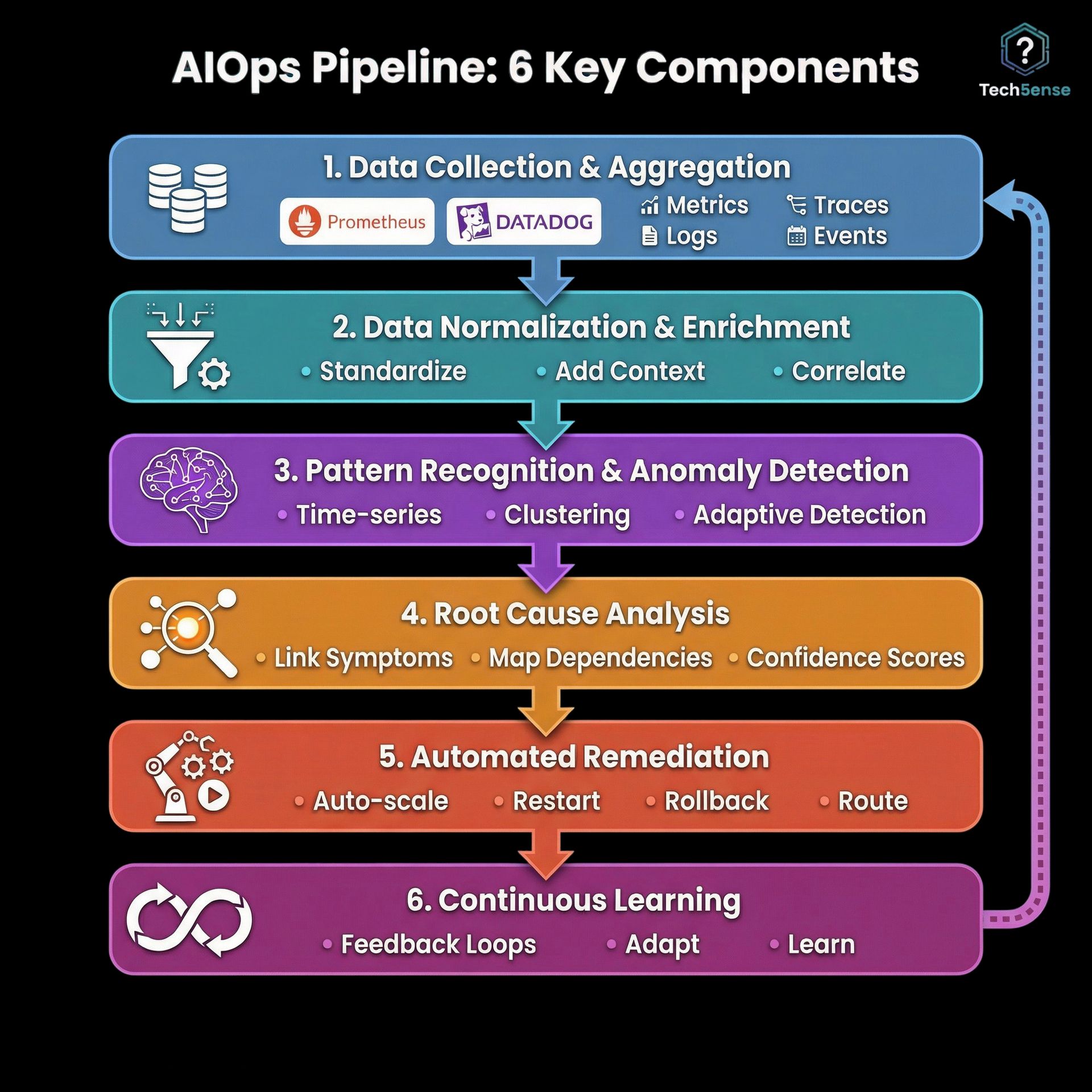
Key Components of an AIOps Pipeline
1. Data Collection & Aggregation
Gather telemetry from everywhere:
→ Metrics: Prometheus, Datadog, New Relic
→ Logs: ELK Stack, Splunk, Fluentd
→ Traces: Jaeger, Zipkin, OpenTelemetry
→ Events: PagerDuty, Jira, ServiceNow
2. Data Normalization & Enrichment
→ Standardize formats across sources → Add context (dependencies, ownership, business impact) → Correlate related events
3. Pattern Recognition & Anomaly Detection
ML models establish baselines of "normal" behavior:
→ Time-series analysis for seasonal patterns → Clustering to group similar issues → Anomaly detection beyond static thresholds
4. Root Cause Analysis (RCA)
→ Link symptoms to underlying causes → Map dependencies between services → Suggest probable root causes with confidence scores
5. Automated Remediation
→ Auto-scale resources → Restart failed services → Roll back problematic deployments → Route issues to the right teams
6. Continuous Learning
→ Feedback loops improve model accuracy → System adapts to infrastructure changes → Models learn from successful remediations
The AIOps Workflow: Observe → Engage → Act
OBSERVE: Ingest real-time streams from your entire infrastructure
ENGAGE: ML algorithms analyze, correlate, and surface insights
ACT: Execute automated responses or guide manual intervention
Real-World Use Cases
1. Proactive Performance Monitoring
Your e-commerce app experiences gradual memory leaks during high traffic.
AIOps detects subtle degradation in response times before customers notice → auto-scales pods → alerts DevOps with root cause analysis pointing to specific microservice.
2. Intelligent Incident Response
Database performance tanks at 3 AM.
AIOps correlates DB metrics with recent deployments → identifies problematic query from new code → automatically rolls back → creates detailed incident report for morning team.
3. Security Threat Detection
Unusual API access patterns emerge from a specific region.
AIOps flags anomalous login attempts → correlates with network traffic data → identifies potential breach → auto-blocks suspicious IPs → escalates to security team with full context.
4. Capacity Planning
Your service needs to handle PEAK traffic.
AIOps analyzes historical patterns → predicts resource needs → recommends infrastructure scaling timeline → auto-provisions resources as load increases.
5. Multi-Cloud Cost Optimization
Cloud costs are ballooning across AWS, Azure, and on-prem.
AIOps identifies underutilized resources → recommends right-sizing → spots zombie instances → predicts cost trends based on usage patterns.
Practice Projects (Start Here!)
Project 1: AIOps for Log Analysis using Isolation Forest (Beginner)
Build your first AIOps system that detects anomalies in application logs using machine learning
Tech Stack: → Python + Scikit-learn → Pandas for data processing → Isolation Forest algorithm → Matplotlib for visualization
Video Tutorial: → AIOps for Log Analysis | First AIOps Project using Python
Project 2: AI Agent for Kubernetes Operations (Intermediate)
Create an AI agent that automates Kubernetes troubleshooting and management using Crew AI
Tech Stack: → Python + Crew AI → Kubernetes API → LangChain → OpenAI or Local LLM
Video Tutorial: → Create your First AI Agent for Kubernetes using Crew AI
Essential Resources
Learning Platforms → KodeKloud; Coursera MLOps Specialization;
Open Source Tools → Prometheus, Grafana, ELK Stack, OpenTelemetry
Automation → Ansible, Terraform, Kubernetes Operators
Communities → MLOps Community (Slack) → CNCF Observability TAG → SRE Weekly newsletter
Hands-on Labs → KillerCoda: Free Kubernetes labs → AWS Well-Architected Labs
How to Actually Build AIOps Skills
Here's the problem: most people bookmark these resources and never use them.
Here's how to actually make progress:
Week 1: Fundamentals → Set up observability stack (Prometheus + Grafana) → Learn basic ML concepts → Understand your current monitoring gaps
Week 2-3: Build Skills → Complete anomaly detection tutorial → Practice feature engineering on real metrics → Create your first automated remediation script
Week 4-6: Real Project → Pick ONE pain point in your infrastructure → Design AIOps solution for it → Build a small functional component and measure results → Share learnings with your team
Then repeat.
That's it for this week.
You now have everything you need to start building AIOps skills ~ for free!!
Keep showing up, keep practicing!
Onwards & Upwards!
-V
Tired of news that feels like noise?
Every day, 4.5 million readers turn to 1440 for their factual news fix. We sift through 100+ sources to bring you a complete summary of politics, global events, business, and culture — all in a brief 5-minute email. No spin. No slant. Just clarity.